
This is a historical blog post, some links included in this post may no longer be active or accurate.
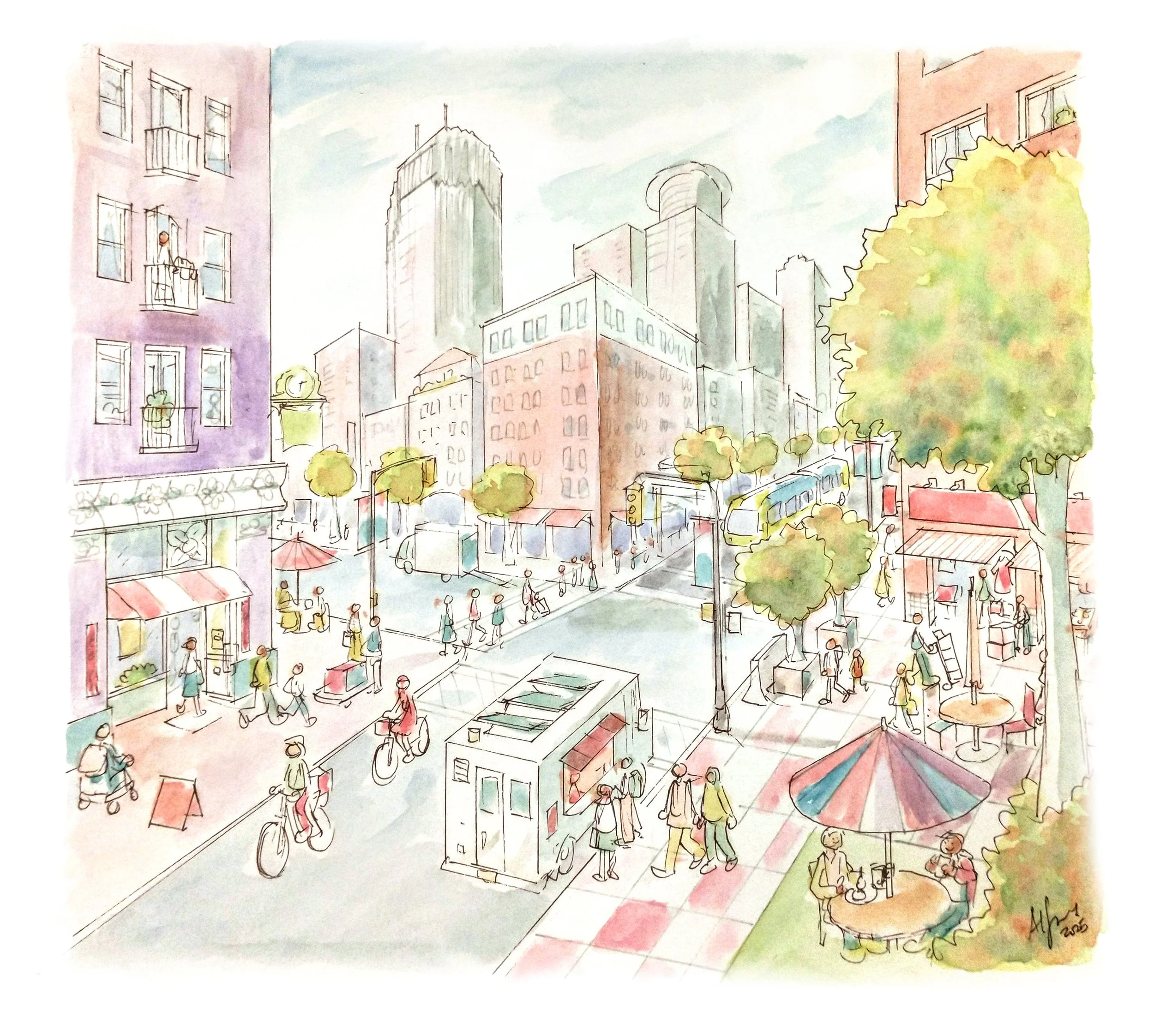
When drive-thrus first began appearing in the 1950s, it was during a period of rapid expansion for cars and they took America by storm. It was seen as the ultimate convenience to run errands or order food without leaving your car. Many cities embraced drive-thrus, but overlooked their negative impacts. Those impacts have now become more obvious in the decades since. Drive-thrus make cities more dangerous and more inequitable, hurt vibrant neighborhoods, strain city finances, and negatively impact the environment.
It is time for cities to use their zoning codes to ban or limit new drive-thrus, to make our communities safer and more connected.
Drive-thrus in urban areas increase the risk for dangerous accidents for everyone. In 1998, a MNDOT study found that roads with more access points had higher crash rates compared to those with fewer access points [1]. The multiple curb-cuts (or auto-focused entrances and exits between the property and the street) that are needed for drive-thrus increase the chances for a car to encounter a person walking or biking. As a driver enters or leaves the property, they will often focus on car traffic, missing the people who are biking or walking directly in front of their vehicle. Drive-thru drivers also create conflict with other drivers. When the line for a drive-thru spills onto a street, it causes congestion that can block a lane of traffic and increase the risk of crashes. A local example is the Starbucks located at Snelling and Marshall in St. Paul, whose drive-thru caused such severe vehicle congestion, it had to be removed.
As drive-thrus gained popularity in the second half of the 20th century, cities changed their zoning codes to accommodate them. Drive-thrus were often built in existing neighborhoods and in locations that were never designed for car-centric uses. Before drive-thrus, we built more vibrant neighborhoods where everyone felt welcomed. Neighborhoods designed before the advent of cars allowed people to easily walk or take transit to a variety of essential goods and services. City codes encouraged large shop windows to allow people to see what was for sale and doors that faced the street for easy access. This began to change when cities started prioritizing cars. Cities and businesses started focusing on replacing walkable, pedestrian-oriented commercial corridors with infrastructure that catered to cars This resulted in changes to our built environment, like moving building entrances from the sidewalk to a parking lot.
Drive-thrus have also made this country more inequitable. Many people are unable to drive a car due to their health, age, or income. The newest trend has been to build a business that only has a drive-thru, without a lobby or walk-up window at all. These types of establishments are blatantly discriminating based on the access to a vehicle.
Drive-thrus can also reduce the tax revenue of cities. Property taxes are one, if not, the most important way cities fund themselves. In a study done in Brainerd, MN, a section of downtown with “people-oriented” development was found to outperform the valuation of a new drive-thru fast-food restaurant by 41%, even though they occupied the same square footage [2].
This shows that freestanding drive-thrus are likely to generate less property tax revenue compared to people-oriented businesses.
Finally, drive-thrus encourage sprawl (you need a lot of empty asphalt space for cars to make them work) and as a city or suburb grows geographically outward without adding more people and homes, it costs more to maintain basic services. Many cities start having financial problems when property taxes and sales taxes are not enough to maintain expensive car-oriented infrastructure. In 2021, a Ramsey County map showed buildings in older neighborhoods have higher valuations than car-centric buildings with drive-thrus. For example, downtown St. Paul provided 9% of the tax base for the city while only taking up 2% of the city’s land [3].
Finally, drive-thrus create more pollution, which impacts both public and environmental health. Drive-thrus create a constant stream of idling cars that emit air pollution, which is harmful for people and can increase the chance for asthma or other respiratory illness. Studies have shown that children who live or attend school with high vehicle traffic have increased risk for asthma due to air pollutants from cars [4]. Idling cars also emit greenhouse gasses that contribute to climate change. At the same time, drive-thrus require lots of impervious asphalt surfaces, which create water runoff that carries pollutants from cars into our waterways. That waterway pollution impacts not only the environment, but the health of our drinking water.
While drive-thrus are a convenient way to conduct business, their negative impacts are often overlooked. They make cities more dangerous for everyone, are detrimental to the health of people and the environment, hurt vibrant neighborhoods, increase inequity, and strain the city's finances. It is time for cities to change their zoning codes to ban or limit drive-thrus; the negatives far outweigh the convenience.
References
[1] Preston, H., Newton, R., Keltner, D., & Albrecht, C. (1998, August NA). Statistical Relationship Between Vehicular Crashes and Highway Access. http://www.dot.state.mn.us/accessmanagement/docs/pdf/research/statisticalrelationships.pdf
[2] Marohn, C., & Quednau, R. (2017, January 30). The Cost of Auto Orientation. Strong Towns. Retrieved October 19, 2024, from https://www.strongtowns.org/journal/2017/1/29/the-cost-of-auto-orientation-rerun
[3] Lindeke, B. (2021, February 16). Per-acre analysis: a unique way of looking at urban economics. MinnPost. Retrieved October 19, 2024, from https://www.minnpost.com/cityscape/2021/02/per-acre-analysis-a-unique-way-of-looking-an-urban-economics/
[4] Gasana, J., Dillikar, D., Mendy, A., Forno, E., & Ramos Vieira, E. (2012). Motor vehicle air pollution and asthma in children: a meta-analysis. Environmental research, 117, 36–45. https://doi.org/10.1016/j.envres.2012.05.001
Written by Bobby Wargo, volunteer with Neighbors for More Neighbors