More Minnesotans, Fewer Options: Why Housing Prices Keep Rising
Over the past decade, the number of households in Minnesota has grown faster than the number of homes built to accommodate them. That imbalance has consequences. When more people are searching for a limited supply of housing, competition increases, and prices rise. This is the basic logic of supply and demand.
Minnesota’s housing challenges are often described as complicated or inevitable. In reality, the core issue is straightforward: demand for homes has grown steadily, while the supply of homes has not kept pace.
Growing Demand for Homes
Minnesota is a great place to live, with strong public institutions, quality employers, world-class universities, and communities that consistently rank high for quality of life.
The data shows that people want to move here, and many choose to stay. According to the Minnesota State Demographic Center, Minnesota’s population is projected to continue growing in the coming decades. While this growth may not resemble the boom years of the past, even moderate population growth means more people need places to live.
Population growth is only part of the growing demand. Household size, the number of people living together, is shrinking, a change being driven by changes at both ends of the age spectrum. When children grow up and move out, they form households of their own. Many are living independently earlier and in greater numbers than previous generations. At the same time, older residents are increasingly aging in place, remaining in their homes long after their children have left, rather than downsizing or moving in with family.
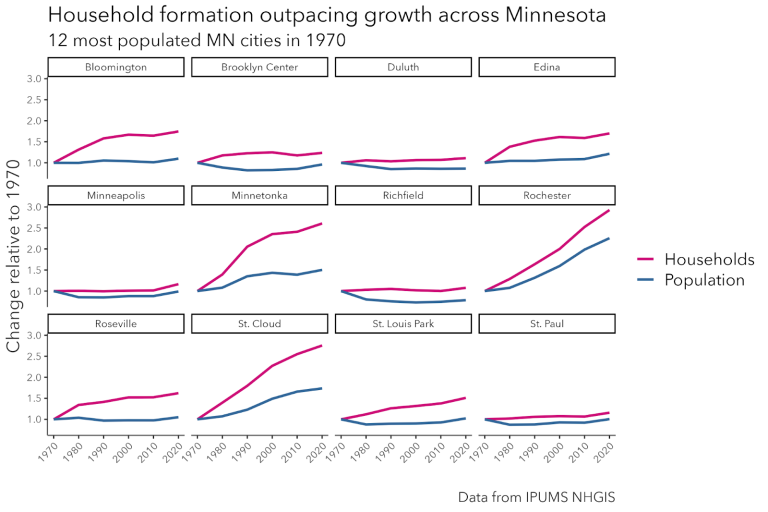
The result is fewer people per household and more households overall. Across the country, more adults are living alone, and couples are having fewer children. Recent local analysis highlighted by Streets.MN shows that in cities like Minneapolis, the number of households has been growing substantially faster than the total population.
Even modest population growth, combined with smaller household sizes, significantly increases the number of homes communities need.
Stagnating Supply
While demand has risen steadily across Minnesota, housing supply has not kept pace. Although Minnesota has built new homes in recent years, the pace of construction has been too slow.
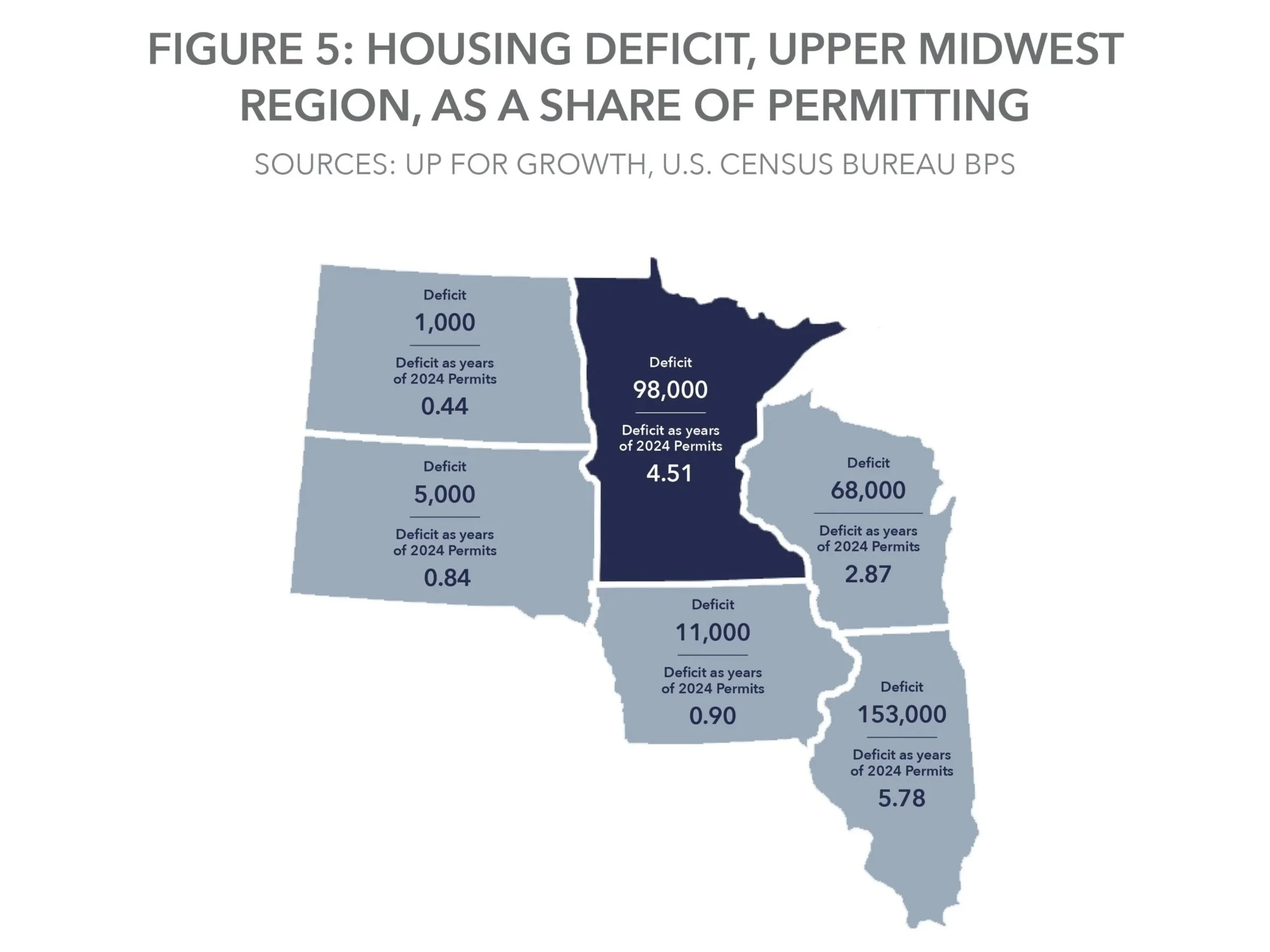
Over the years, the gap between housing supply and demand has widened. Research from the Housing Affordability Institute shows the state is short roughly 100,000 homes.
When supply cannot adjust to meet demand, shortages become long-term structural problems rather than temporary gaps.
Minnesota’s housing challenge was not caused by a sudden collapse of development. Like many places across the United States, it is the result of years of underbuilding relative to the needs and demands of residents.
High Demand + Low Supply = Rising Prices
When there are more households looking for homes than there are homes available, people compete. This competition is not an Olympic event. It's a bidding war for starter homes, yearly rent increases that arrive like clockwork, and refreshing Zillow, only to see blank screens for anything within your price range.
This is not a fair competition either. Recent analysis from the Federal Reserve Bank of Minneapolis found that lower-income home shoppers in the Twin Cities had fewer available options and faced higher costs. As prices rise, the number of homes affordable at lower income levels shrinks quickly.
For higher-income households, competition may mean paying more or compromising on preferences. For lower-income families, the trade-off is often more fundamental: whether any home is available at all.
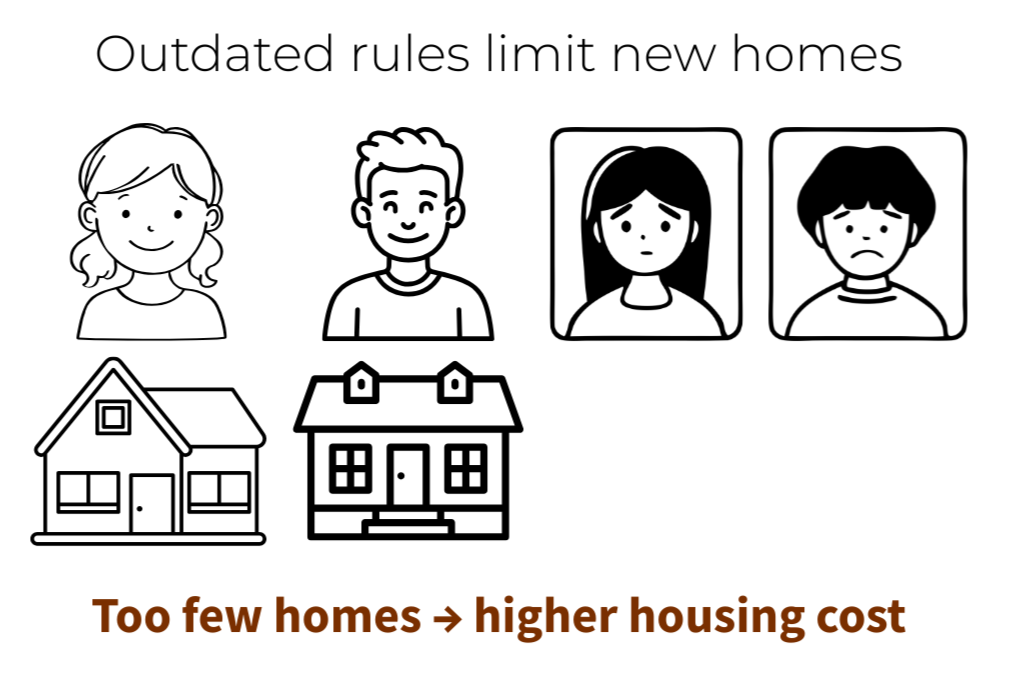
Graphic showing too few homes means higher housing costs. As people compete for fewer homes, some won’t find a home that fits their needs.
Unlock Supply with Reform
Some of the challenges facing new home construction are global and complex. Interest rates, labor shortages, and material costs all affect housing prices and availability.
But one of the biggest barriers to housing construction is local, and it is one of the fastest and most straightforward ways to address our housing shortage. It rests in how our cities allow, or refuse to allow, land to be used.
For decades, many communities have maintained large minimum lot-size requirements that mandate significant yard space for every home, regardless of whether a young professional or an aging senior wants to maintain a yard. Cities also set arbitrary caps on the number of units allowed in apartment buildings before real concerns like traffic, parking, or stormwater are even evaluated. In many neighborhoods, modest duplexes, triplexes, and starter homes are simply not permitted. These rules limit supply before a project is ever proposed.
Allowing more homes to be built within existing communities gives people more choices and reduces competition for a limited number of units. When supply can adjust to demand, price pressures ease across the housing market. Over time, this helps stabilize rents and home prices.
This is why state action matters so much. The Starter Homes Act would modernize outdated local housing rules, allow more homes to be built, and enable the housing market to respond to demand. By creating room for more housing types, we can allow supply to naturally grow alongside Minnesota’s demand.
If we want a Minnesota where teachers, nurses, tradespeople, young families, and seniors alike can afford to live near their work, friends, and families, we need to allow more homes to be built.
The economics are straightforward. When demand rises and supply is constrained, prices increase. If we want affordability, Minnesota needs more homes.
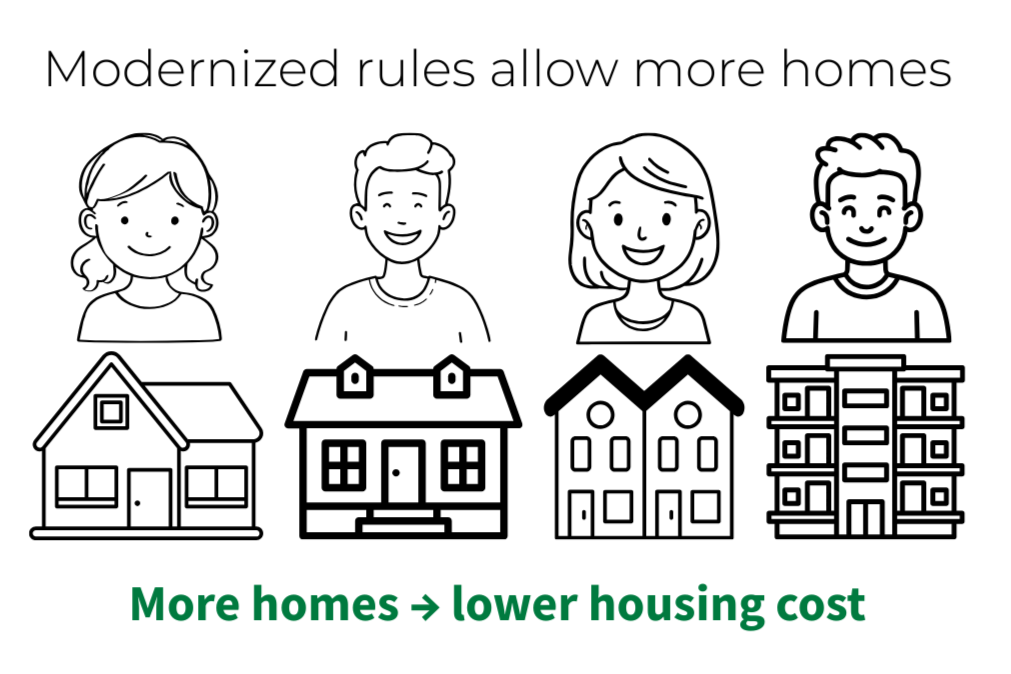
Graphic showing more homes means lower housing cost as everyone can find a home that fits their needs.