Making an Impact at the Capitol: How to Testify and Talk to Your Legislator
The Minnesota legislature starts its 2026 session on February 17th, and Neighbors for More Neighbors and our partners at the Yes to Homes Coalition are gearing up to continue advocating for policies that legalize more homes in more places across our state.
To help our supporters feel empowered to engage and influence the legislative process, we put together this short lesson on how you can contact and meet with your lawmakers about the issues you care about and even testify at a legislative hearing.
Understanding the Legislative Session
The legislative session follows a rhythm; knowing the key dates and events helps you understand when to best target your engagement. The graphic below gives a good primer to this year’s session. The deadlines listed below indicate the dates by which a bill must have had a committee hearing in order to move forward.
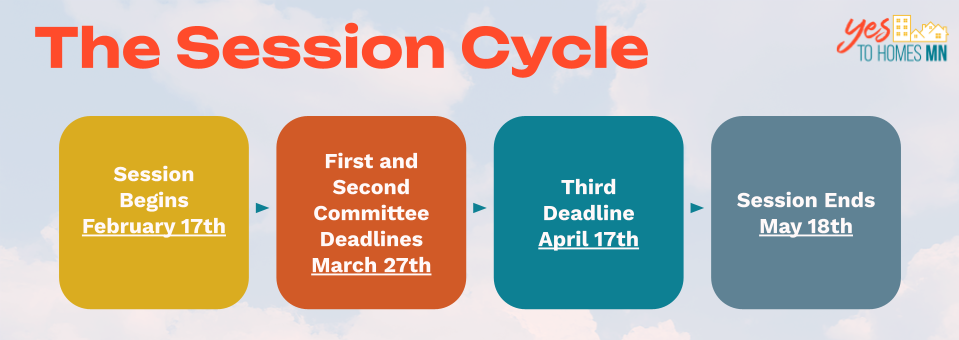
The Session Cycle Graphic.
It is usually best to try to meet with your lawmaker between the start of the session and the first committee deadline. After the first deadline, lawmakers are generally busier and have less time for constituent meetings. This year, that period is between February 17th and March 27th.
Scheduling a Meeting With Your Representative
The process for scheduling a meeting with your lawmaker can be confusing, but following the steps below can streamline it.
Find out who your state senator and representative are. If you don’t know already, you can visit the Who Represents Me page on the legislative website and type in your address.
Find their contact info at the legislative website.
Send an email requesting a meeting. A sample email can be found here. Be sure to include their legislative assistant on any communication you send to the lawmaker. Their legislative assistant is responsible for scheduling the elected official’s meetings.
If you don’t hear back in five to seven days, consider following up with a call and leaving a voicemail if no one answers. Always remember to be concise and polite.
The Meeting Itself
Meetings with lawmakers during the legislative session typically last 10 to 15 minutes and can be in person or virtual. Before the meeting, practice what you want to say. It is good to arrive early so you can find the meeting location and be flexible with timing, as lawmakers' schedules often change due to committee hearings or other meetings running long.
Come prepared with handouts that you can leave behind for the lawmakers that summarize your main points and the bill you are supporting or opposing. Don’t hesitate to contact us if you are looking for the latest handouts you can bring to a meeting this session.
Sometimes, lawmakers are available to meet in their district. These meetings are often longer and held outside the legislative session or on weekends.
Testifying at a Committee
Aside from meeting with your lawmaker, one of the best ways to make your voice heard at the state capitol is by testifying at a committee hearing. This can be done either in person or by submitting written testimony.
How to Know When It's Time for a Hearing/Tracking Bills
Often, organizers with Neighbors for More Neighbors and the Yes to Homes coalition will alert you when opportunities to testify arise and will help you prepare. You can also sign up to track when bills you are interested in are getting hearings using the MyBills function on the Minnesota legislature website. You can also sign up to receive updates for specific committees in order to get notified when hearings are coming up and what bills are being heard. Below is a list of committees most relevant to the Yes to Homes agenda.
Senate
House
Signing Up to Testify (In-Person or Written)
When a bill is scheduled for a committee hearing, the meeting notice will be posted on the committee's webpage and will include instructions on how to sign up to testify or submit written testimony. This will involve emailing the committee administrator.
Tips and Tricks for a Successful Testifying Experience
Be respectful.
Try to make a personal connection if possible.
Trust other people to tackle different angles. Focus on your story.
Keep your testimony to two minutes! Be prepared to make it even shorter if needed.
Make sure to fully write out your testimony, practice beforehand, and speak slowly and clearly.
You may be asked questions, but probably not.
Testimony Checklist
This checklist can be used to draft a written testimony or to prepare what to say when testifying in person. Just remember to keep it short. Written testimony should be a page or less, and oral testimony should be under two minutes.
Name
Organization/Affiliation & Role (Staff Title, Volunteer, Resident)
Topic or Bill Number (House File xxxx or Senate File xxxx)
Your position on the proposed legislation and “why.”
What is the impact of the proposed legislation? How would these bills help build more homes?
End with, “Thank you for the opportunity to testify today.”
Sample Testimony
Below is a short template that can be used when preparing written or oral testimony:
Chair and members of the committee,
My name is (insert name), and I live in (insert city where you live). I am here to testify in support of/in opposition to (insert bill number or name). I support/oppose this bill based on my personal experience with this issue.
(Provide a brief explanation of reasons for supporting or opposing the issue.)
Thank you for the opportunity to testify on this important issue.
We hope that this legislative session, you will step up and make your voice heard. To pass statewide pro-homes legislation, we need Minnesotans across the state to speak out in support of allowing more homes in more places.