Local Control Cannot and Will Not Solve Minnesota’s Housing Crisis
Opponents of statewide housing reform often argue that cities should retain full control over zoning. According to this view, local governments will gradually update their own rules in ways that reflect the character of their communities.
But “local control” has already had decades to modernize zoning, and the results are clear. Across much of the metro area, development rules adopted in the mid-20th century remain largely unchanged (1). Blaine’s recent experience with accessory dwelling units (ADUs) illustrates why relying on cities alone to change their laws has rarely produced meaningful reform.
2021: Blaine Legalizes ADUs
In 2021, the City of Blaine adopted new zoning regulations permitting Accessory Dwelling Units (2). According to the public record, Blaine’s Planning Commission, City Council, and the lone public commenter all expressed overwhelming support for allowing ADUs in the city (3) as a way to help address housing costs and provide additional options for residents who wished to age in place.
The ordinance was far from a carte blanche authorization for ADUs. It required 10-foot setbacks, architectural similarity to the primary house, and made ADUs subject to review through a Conditional Use Permit (CUP). Conditional Use Permits allow certain uses of property that may be appropriate in some circumstances but require a public hearing and a case-by-case review. Applicants must demonstrate that the proposal meets the standards outlined in the zoning ordinance, after which the City Council determines whether to approve the permit and whether any conditions are necessary to mitigate impacts on nearby properties. Because CUPs involve discretionary review and a public hearing, they can become flashpoints for neighborhood opposition even when proposals meet the technical standards of the ordinance.
2025: The First ADU Application
After the ordinance was adopted in 2021, more than three years passed without a single application (4). In early 2025, Alex and Lynda Pepin applied for a CUP to construct a one-story 616-square-foot ADU in their backyard. For reference, this is about the size of a typical studio apartment and comparable in height to many prefabricated backyard sheds.
The ADU met or exceeded all of Blaine’s requirements, including being setback farther than required from property lines, proposing dense plantings between the structure and the park, and using residential vinyl siding. The proposed ADU received strong support from the city’s professional planning staff (5) and was recommended for approval by the Planning Commission (6).
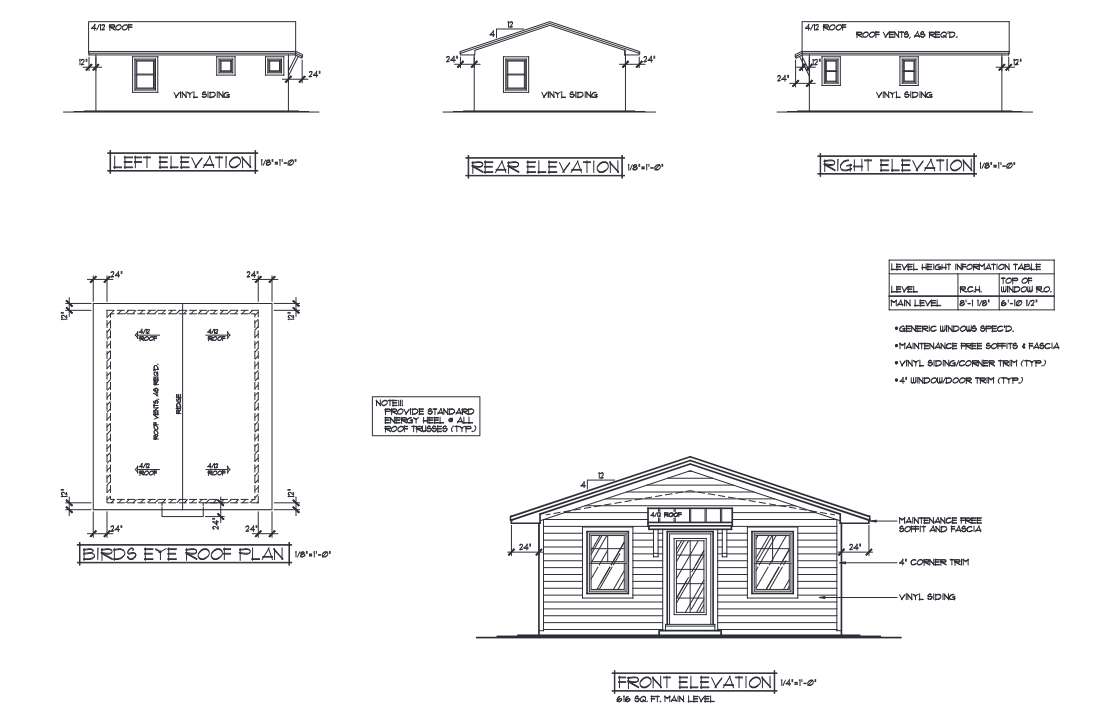
Proposed Exterior of the Pepin ADU (7)
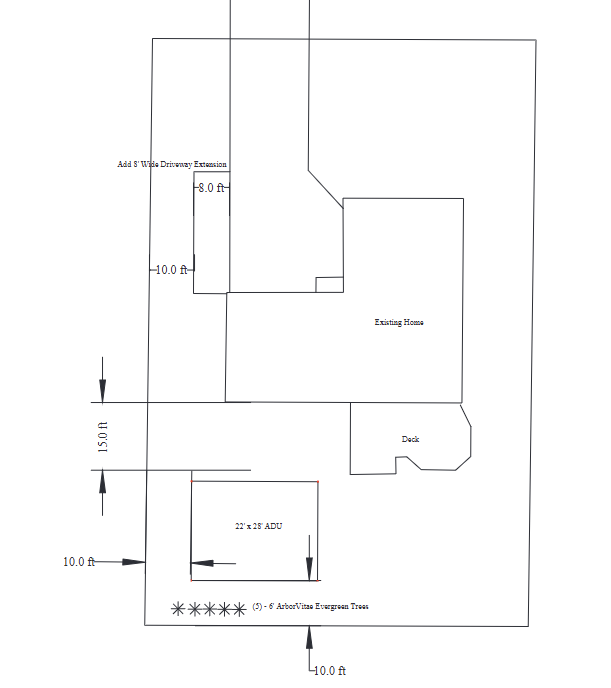
Proposed Placement of the Pepin ADU (8)
The Pepins originally intended to rent the ADU to families transitioning out of homelessness through a nonprofit program connected to Mr. Pepin’s work. Blaine’s ordinance allowed ADUs to be rented to non-family members as long as the property owner lived on the site, which the Pepins intended to do.
2025: The Public Hearing Process
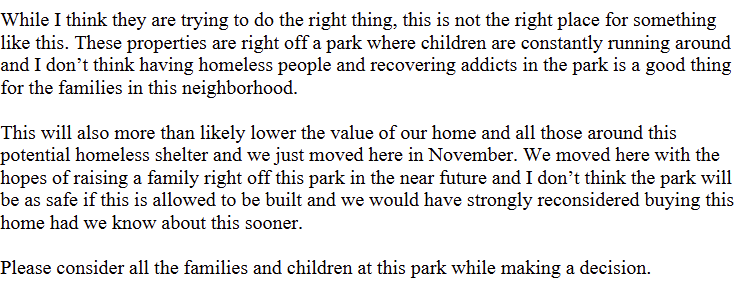
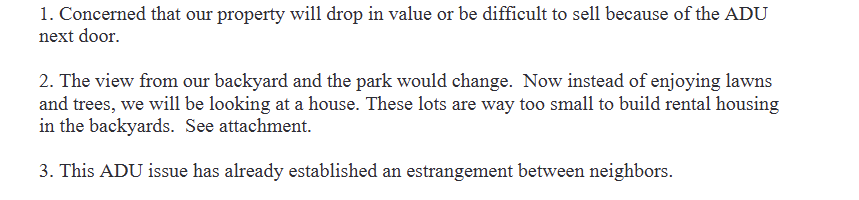
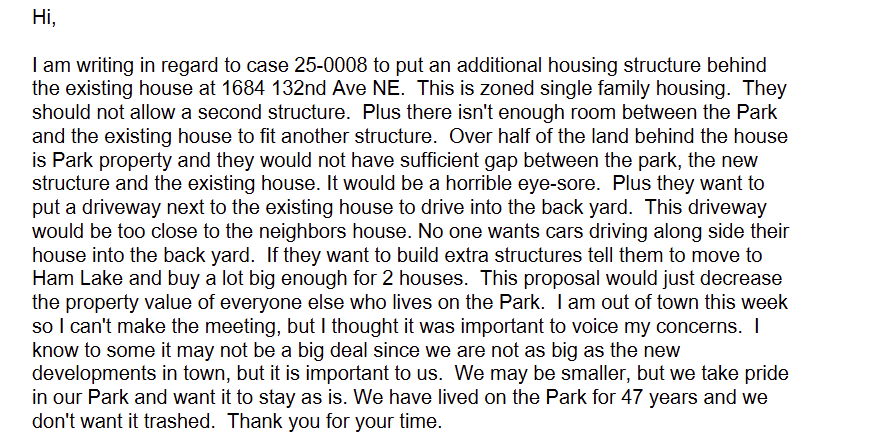
Because the CUP process requires a public hearing, nearby residents were notified of the proposal and invited to comment. Several neighbors raised concerns about renters occupying the unit, speculated about potential crime, and, without evidence, expressed fears that the structure would lower nearby property values (9).
Some comments from the public record included:
“This will destroy our enjoyment of our backyard.”
“We have lived on the Park for 47 years and we don't want it trashed.”
“I don’t think having homeless people and recovering addicts in the park is a good thing for the families in this neighborhood.”
“This home will block our view of the sun and sky.”
“It would be a horrible eyesore.”
Despite the proposal meeting the ordinance’s standards and receiving support from planning staff and the Planning Commission, the City Council denied the request at its May 5, 2025, meeting (10). Council members, mainly acknowledging the above concerns of people who live nearby, stated that the proposal did not align with the perceived “intent” of the ADU ordinance and expressed concern that the potential for four additional residents in the ADU would “overburden” the nearby city park.
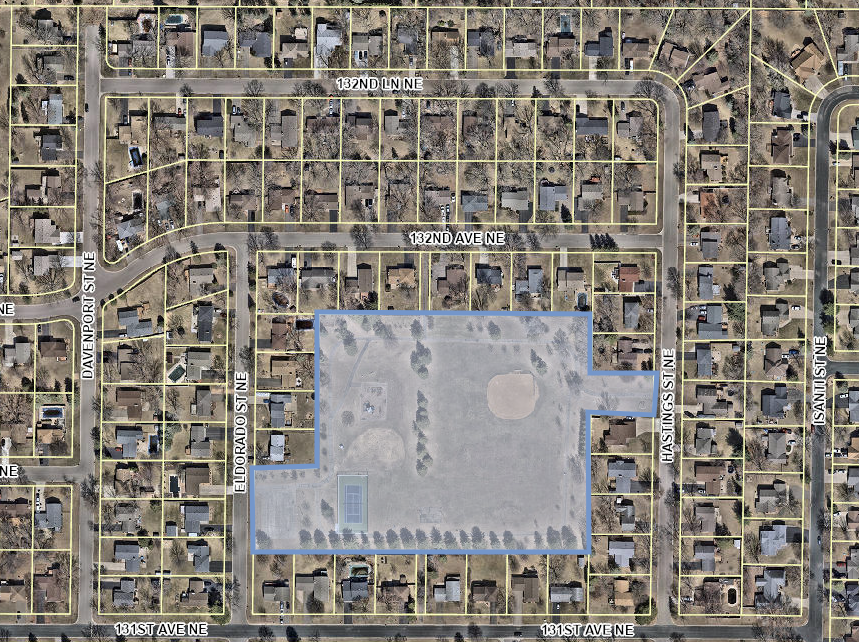
The park that would be “overburdened” if four additional people were allowed to live near it…
Image from Anoka County GIS
The Pepins revised their proposal, stated they would not rent the structure, and resubmitted it. The Council denied the request again (11).
2026: Blaine Reverses Course
The Pepins have now filed legal action against the City of Blaine, alleging that their application was wrongfully denied (12). If the Pepins prevail in court, the city could face financial damages and would likely be required to allow the ADU to be built.
Following the controversy, the City Council placed a pause on new ADU applications and is now changing its zoning code to prohibit detached ADUs altogether (13), reversing the policy just adopted in 2021.
Notably, one of the public comments opposing the proposed ban on detached ADUs came from the St. Paul Area Association of Realtors (SPAAR) (14). Realtors noted that additional housing options, like ADUs, can expand supply and provide flexibility for homeowners, a position that contrasts sharply with claims that the Pepins’ small backyard unit would somehow harm nearby property values.
If Not Blaine, Somewhere Else
Blaine is the perfect illustration of how so-called “local control” functions in practice. When even modest housing reforms encounter political pressure from a vocal minority of residents, efforts to modernize outdated zoning rules and expand housing options for current and future residents of the metro area are halted in their tracks.
There are about 180 jurisdictions in the Twin Cities metropolitan area. If each city must independently debate, adopt, defend, and potentially relitigate even modest zoning reforms, as Blaine’s experience demonstrates, progress will remain glacially slow and uneven.
While some communities have adopted ADU ordinances with comparatively little fanfare (15), ADUs represent only a small part of the broader housing challenge. Allowing modest increases in housing options, such as duplexes, townhomes, or smaller minimum lot sizes, will generate similarly charged debates in community after community. If every reform must survive hundreds of separate local political battles, meaningful progress will be difficult, if not impossible, to achieve.
The public record is clear. “Local control” has had decades to modernize zoning. The results speak for themselves.
State reforms such as the proposed Starter Homes Act would allow modest, sensible projects like the Pepins’ ADU to move forward without turning each individual proposal into a prolonged and needless local controversy.
References:
https://www.moreneighbors.org/news-stories/the-hidden-rule-shaping-minnesotas-housing-market
https://blaine.legistar.com/View.ashx?M=F&ID=10345234&GUID=037BD058-8BB4-4A78-9E4E-24F5B8CEB39E
https://www.startribune.com/blaine-homeless-accessory-dwelling-unit/601357999
https://blainemn.portal.civicclerk.com/event/1082/files/report/3675
https://blainemn.portal.civicclerk.com/event/1082/files/attachment/3599
https://blainemn.portal.civicclerk.com/event/1082/files/attachment/3563
https://blainemn.portal.civicclerk.com/event/1082/files/attachment/3563
https://blainemn.portal.civicclerk.com/event/1082/files/attachment/3634
https://blainemn.portal.civicclerk.com/event/1094/files/attachment/3684
https://www.startribune.com/blaine-homeowner-accessory-dwelling-unit/601457365
https://www.startribune.com/lawsuit-blaine-city-adu/601394274
https://blainemn.portal.civicclerk.com/event/1246/files/report/6132
https://blainemn.portal.civicclerk.com/event/1246/files/attachment/6977
https://www.startribune.com/twin-cities-suburbs-accessory-dwelling-units/601438149