
Where rents are rising the most? And how we can fix it.
Minnesota has recently shot to the top ten of a list comparing states this year. Unfortunately, instead of measuring the highest quality of life, best resident health, or lowest poverty rates, this list ranks the largest rent increases from this time last year.
Average Rents Are Climbing Fast
A new analysis based on the Zillow Observed Rent Index (ZORI), a tool that averages rents from all kinds of homes across the nation, paints a pretty stark picture. In all but seven states, average rents are rising faster than inflation. [1]
Sadly for us Minnesotans, we nearly top this list. According to the ZORI, Minnesota saw rents soar 5.74% between 2024 and 2025, putting us behind only West Virginia for the fastest-growing rents in the nation.
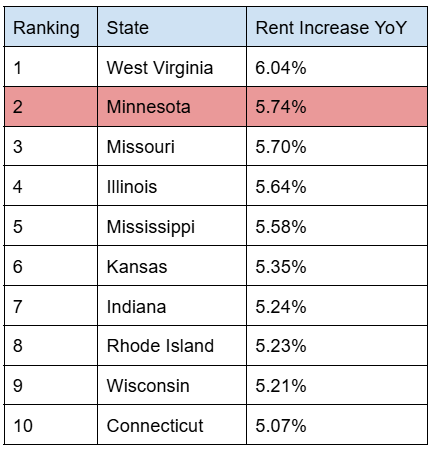
Table showing top ten states with highest year-over-year rent increase by percentage.
A Closer Look
The ZORI is split into two categories, each available by metro area: [2] single-family residences, where each home is in its own detached, separate building, and multi-family residences, which include duplexes, apartment buildings, and other types of buildings where multiple homes are under the same roof.
In most cities across Minnesota, as well as the country as a whole, rents in single-family homes increased more than rents in multi-family homes. Nationwide, the increase for single-family homes was about 83% more than the increase for multi-family homes. This is on top of the fact that rents for single-family homes are already higher, charging a premium relative to the amount of space these homes occupy in our cities.
Surprisingly, the four biggest metro areas in Minnesota—the Twin Cities, Duluth, Rochester, and St. Cloud—sit below the state average in one or both types of homes, while all of the data for smaller cities show rents rising faster than the already-high state average.
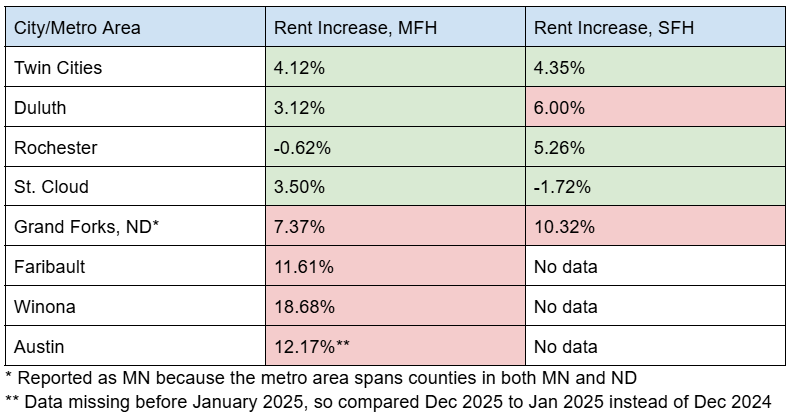
Table showing Minnesota cities or metro area year-over-year rent increases by percentage for Multi-Family Homes (MFH) and Single-Family Homes (SFH)
Fewer Homes = Faster Rent Hikes
What do these cities with faster-growing rents have in common? For the most part, they aren’t building many new homes.
According to data from the Census Bureau [3], Faribault only built 86 new homes from January to October last year, all of which were single-family homes. Winona only built 41 new homes, 22 of which were single-family.
On the other hand, Duluth built 490 new homes, St. Cloud built 521 new homes, Rochester built 666 new homes, and the Twin Cities built a healthy 12,267 new homes between January and October last year.
It isn’t just city size that determines how many new homes are built, either. For example, St. Cloud built one new home for every 395 residents, but Faribault only built one home for every 803 people, and Winona one for every 1,219 people.
The trend is much the same in other states with fast-growing rents. Cities that build fewer new homes see rents climb faster. Beckley, West Virginia, which saw its rents soar 10.52% last year, only built 70 homes, one for every 1,585 residents. St. Joseph, Missouri, with rents climbing by 6.83% for multi-family homes and 9.79% for single-family homes, only built one home for every 1,833 people.
More Homes = More Affordable Rents
We’ve looked at states where rents grew the fastest, but what about the opposite? The states with the most stable rent prices are:
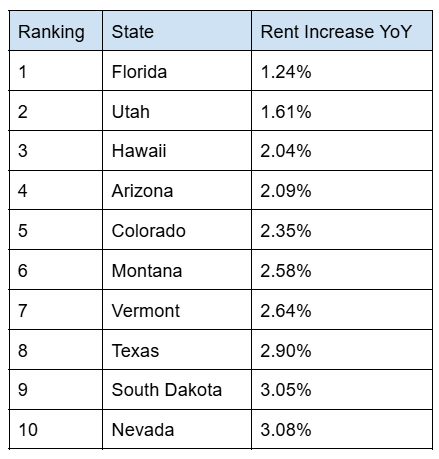
Table showing top ten states with lowest year-over-year rent increase by percentage.
These states aren’t keeping rents down simply because people aren’t moving there. Florida, the fastest-growing state in the United States [4], sits conspicuously at the top of the list, and it’s easy to see why: they are building new homes at a breakneck pace.
The Cape Coral-Fort Myers metro area, for example, built an astonishing 12,150 new homes, including 3,239 new multi-family homes, just in the first ten months of last year. That’s almost as many homes as Chicago built in the same time, despite that this Florida city is eleven times smaller. The outcome couldn’t be more clear: rents for multi-family homes fell by 6.4%, while rents for single-family homes fell by 2.7%.
It’s not just Florida, either. Austin, Texas, has repeatedly made headlines in news outlets nationwide. [5] It’s one of the top 25 largest metro areas in the country, as well as one of the fastest-growing, but rents fell over the past year.
How did they do this? They built 22,919 new homes, over 10,000 of which are multi-family homes. That’s one new home for every 111 residents! Despite being the 25th-largest city in the country, it built more new homes than Los Angeles, the second-largest.
A Peek Across the Border
Our next-door neighbor, South Dakota, found a spot on the list of slowest-growing rents, and it’s no coincidence.
Sioux Falls built one new home for every 153 residents, and rents rose less than 1%. And it’s not all car-dependent sprawl, either! The outer edge of the city, where most of this new development is taking place, has pedestrian-oriented streets, townhomes, duplexes, apartments, and mixed-use neighborhoods, notably what their Planning & Development Services department calls “live-work” zones. [6][7]
Rapid City, an even smaller city with a metro population of about 156,000, still built 850 homes last year, which helped keep its rent increases to less than 2%.
These cities didn’t build those homes by accident. In 2024, the Sioux Falls planning commission changed the zoning of 41 areas within the city. [8] These changes included allowing more multi-family homes to be built and the development of new mixed-use neighborhoods. This strategy is part of the city’s 2040 comprehensive plan, which includes provisions to “develop neighborhood schools, parks and community centers, commercial service centers, and a mix of types and densities in all neighborhoods.” [9]
What Can We Do?
Minnesota doesn’t have to be on the worst end of the rent-hike stick. We can keep homes across the state affordable, too, but we need to take action.
Right now, cities across Minnesota have widely different rules about what kinds of homes can be built where, how big of a yard they need to have, even whether or not a neighborhood requires a homeowner’s association. This makes it harder to build new homes, driving up the price both to buy and rent, and making stable housing harder to afford for average Minnesotans.
Neighbors for More Neighbors, as part of the Yes to Homes coalition, is pushing for statewide action: a reform to the rules we put on building homes. As the state legislative session approaches, we’re part of a statewide effort to pass legislation that would give cities and towns across Minnesota the tools they need to expand housing choices, cut red tape, and help our communities thrive. Keep an eye out for ways to help this bill get passed, and make it easier for all of our neighbors to find a place to call home!
[2] https://www.zillow.com/research/data/
[3] https://www.census.gov/construction/bps/current.html
[4] https://smartasset.com/data-studies/population-2025
[5] https://www.kut.org/austin/2024-06-13/austin-texas-rent-prices-falling-2024
[6] https://www.siouxfalls.gov/government/departments/planning-development/zoning/zoning-interface-web
[7] https://propzone.gridics.com/city/us/sd/minnehaha-county/sioux-falls
[8] https://issuu.com/siouxfalls/docs/pds24_052_planning_commission_annual_report