
Why and How Other States Have Taken Action on Housing Reform
If you’ve been following along with our recent blog posts, you’ll know that policy is an important part of building enough homes for all of our neighbors. Whether it’s zoning changes that make more types of homes possible in more places, allowing lots to be divided to build more homes in existing neighborhoods, or changes like parking mandate limits in existing zones, policy is a key factor in ensuring enough homes are built in our communities.
One important question still remains: Why are these policies needed at the state level?
Local Control Is More Restrictive
In states where more homes are needed the most, it is often cities and counties that are responsible for the stricter limits on what homes can be built where. About three-quarters of residential areas in US cities are zoned for only detached, single-family homes. Cities and towns often require homes to be built on large lots, with arbitrary requirements for the number of parking spaces per home. The Bay Area in California, despite seeing some of the highest home prices in the country, is notoriously restrictive.
Even as some of the nation’s largest cities like Portland, Oregon, and Houston, Texas lead the charge on reducing these restrictions on a local level, or even eliminating them entirely, suburbs and smaller cities within their metros keep highly restrictive rules in place. Even as Houston has turned heads with its hands-off approach to zoning, Deer Park and Galveston, two municipalities in the same metro area, are in the top 20% of municipalities for most restrictive regulations.
Minnesota has its fair share of similar stories. Minneapolis has made headlines for effectively eliminating the requirement that homes in certain areas be single-family only. But Blaine, a suburb of the Twin Cities, recently made headlines for quite the opposite reason: prohibiting an accessory dwelling unit from being built on a lot zoned for single-family housing only.
States Step In With “Reverse Regulatory Overreach”
As the shortage of homes across the nation has worsened, states have increasingly stepped in to combat unnecessary and restrictive zoning practices within their borders. For example, 18 states have passed laws that allow more ADUs to be built, from weakening restrictions on where they can be built to outright requiring that they be permitted on all single-family lots in municipalities. Arizona even expanded an existing law to include unincorporated areas–often rural areas outside of city limits, which are subject only to county and state regulations–ensuring that rural homeowners can add more homes when they are needed without splitting their land into multiple lots.
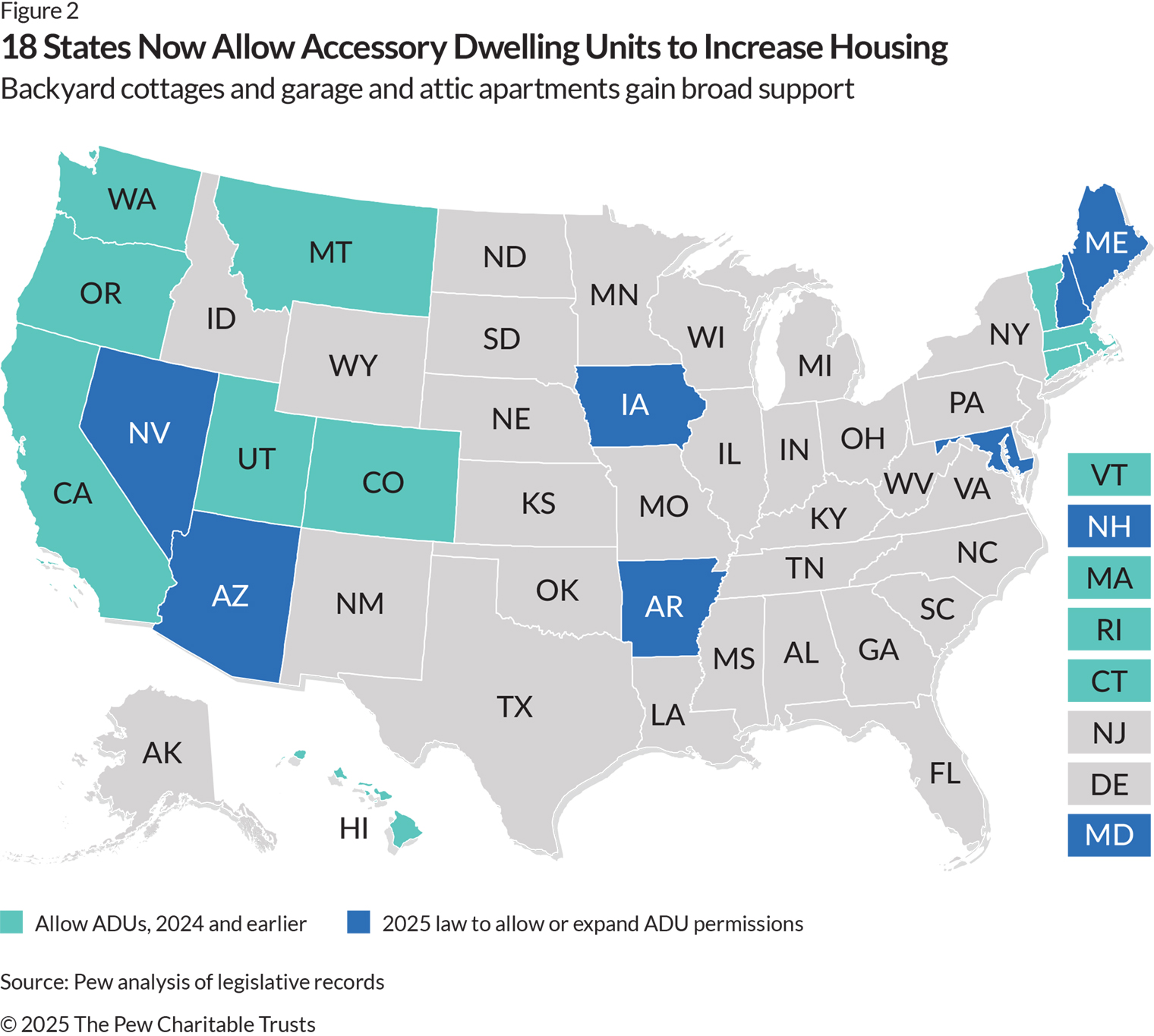
Expanding where ADUs can be built isn’t the only tool states have used to tamp down restrictive local zoning. States across the nation have passed laws that relax or eliminate restrictions on new apartments, condos, and townhomes from being built in areas zoned for commercial buildings, ease the conversion of empty office buildings into new homes, and make mixed-use developments possible. By requiring that cities relax these restrictions, states like Texas, Maine, and Montana make it easier to build homes among the places their residents work, shortening commutes and easing the housing shortage at the same time. Meanwhile, states like Washington and Hawaii have passed laws that make apartments and condos easier and cheaper to build near transit stops, making existing infrastructure work better for residents in all cities within their borders.
While changing where homes can be built is a powerful tool, it is just as important to make sure those homes make sense in the neighborhoods they are built. Urban cores can’t accommodate large lots and lots of parking without sending home prices and property taxes skyrocketing, but municipalities often have arbitrarily large minimum lot sizes on urban single-family homes or require more parking spots than homes for apartment buildings.
States have stepped in here, too. Texas and Maine have capped minimum lot sizes that cities can require, making it easier to build more homes and reduce infrastructure costs across those states. Texas, New Hampshire, and Montana have all prevented localities from requiring arbitrarily large parking mandates, with Washington going so far as to eliminate parking minimums entirely for small homes, subsidized housing, and senior living facilities.
States Can Ensure Safety Without Unnecessary Regulations
Building codes are a crucial part of public safety; they help homes and businesses reduce the risk of emergencies like fire or structural collapse while ensuring these buildings remain accessible to people with limited mobility or health issues. But oftentimes, they impose restrictions that may not make sense everywhere, and don’t actually improve safety.
Most states and cities require that apartments over a certain size have two stairwells to ensure that people can exit safely in the event of a fire. That’s certainly important for large buildings with many floors, but oftentimes, these requirements are set suffocatingly low. A study our state did just last year found that larger apartment buildings, even with as many as eight floors, can be designed with a single stairwell without compromising safety. As studies like this one have emerged, states like Texas, Colorado, Montana, and New Hampshire have passed laws that allow single-stair buildings up to four to six floors, making these medium-sized multi-family homes cheaper to build and maintain.
Elevators, too, are subject to building code requirements that often don’t make sense for smaller apartment buildings. About Here and Sightline Institute recently released a video explaining why elevators cost roughly three times as much in the US and Canada compared to other high-income countries. As a result, smaller multi-family buildings often can’t justify the expense of building a large elevator, or they do so by increasing rent or condo fees quite drastically. In response, Washington state legislators introduced a bill last year that would allow buildings up to six stories to use these smaller elevators, ensuring safety and accessibility at a much lower cost to developers and residents alike.
Permitting: The Final Hurdle
Even after a home is planned in the right zone and designed to be up to code, construction permits are one additional step that can slow down the building of new homes. There’s often a sort of catch-22: Permits are necessary to ensure that homes are built safely and meet requirements, but high-demand areas can inundate municipalities with permit requests that clog up new development. Even if a city wants a certain type of home to be built, permits can still make building new homes harder!
Some states have brought their own approaches to streamline the permitting process and make it less of a headache for all involved. Arizona allows single-family homes to be approved by dedicated third-party professionals, freeing up city and county resources and allowing more homes to be built. Rhode Island has made electronic permits more widely available across the state. California has carved out exceptions in its Environmental Quality Act for multi-family homes in urban areas–where the land is already developed and a new building won’t degrade any natural areas–making building new homes a little easier in a state notorious for its strict and lengthy permitting process.
Minnesota Needs These Reforms, Too!
Our state faces a shortage of over 100,000 homes. Even as cities like Minneapolis ease restrictions on new homes and build homes in large numbers, having a patchwork of policies makes it harder to build the homes our neighbors need across the state. We need statewide policy to simplify regulations and ease local restrictions. This year, we’re working to pass the Yes to Homes bill to ensure that people across Minnesota are able to find the right home for them in their community. Find out ways you can help us get this passed here!